Seed · possibility
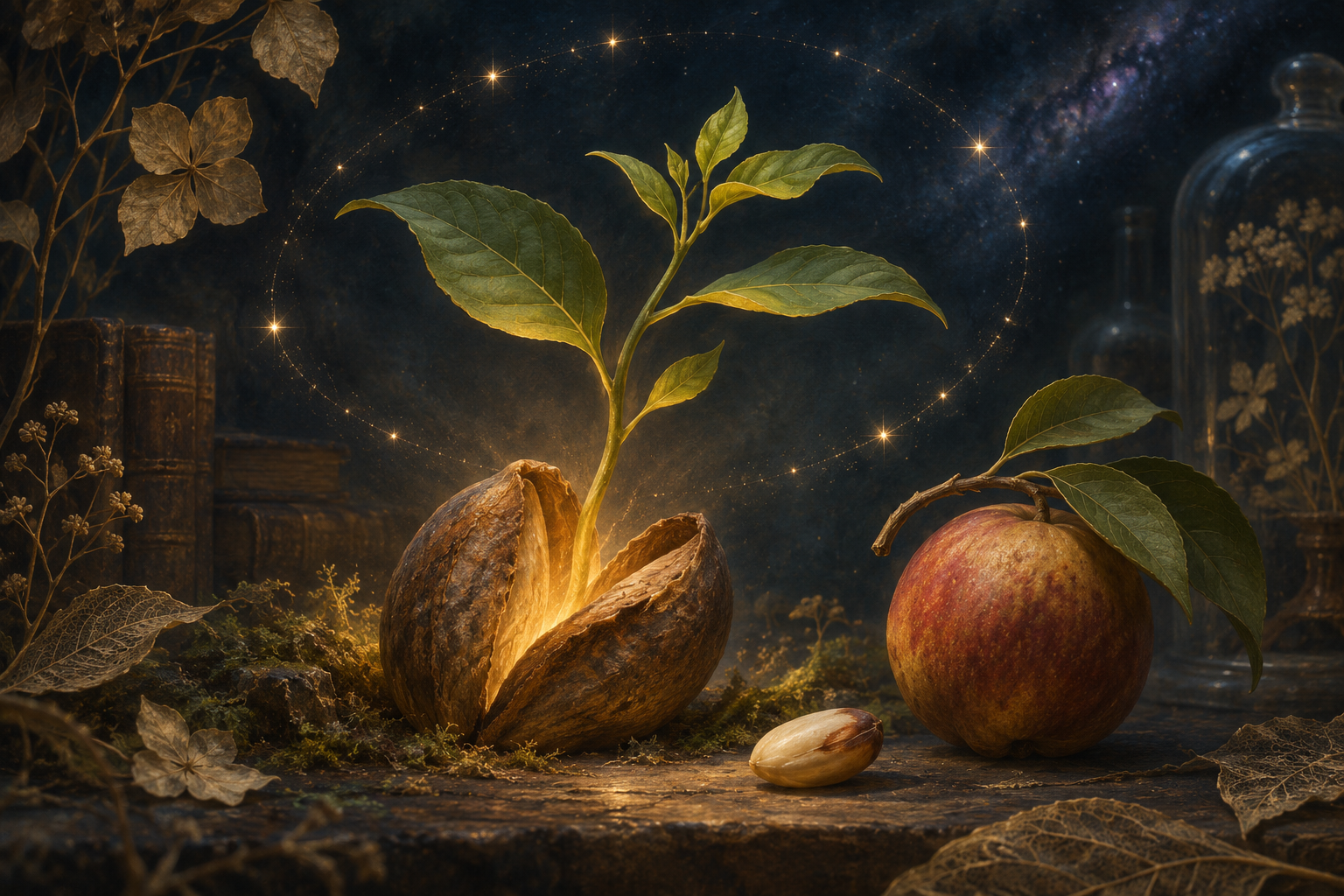
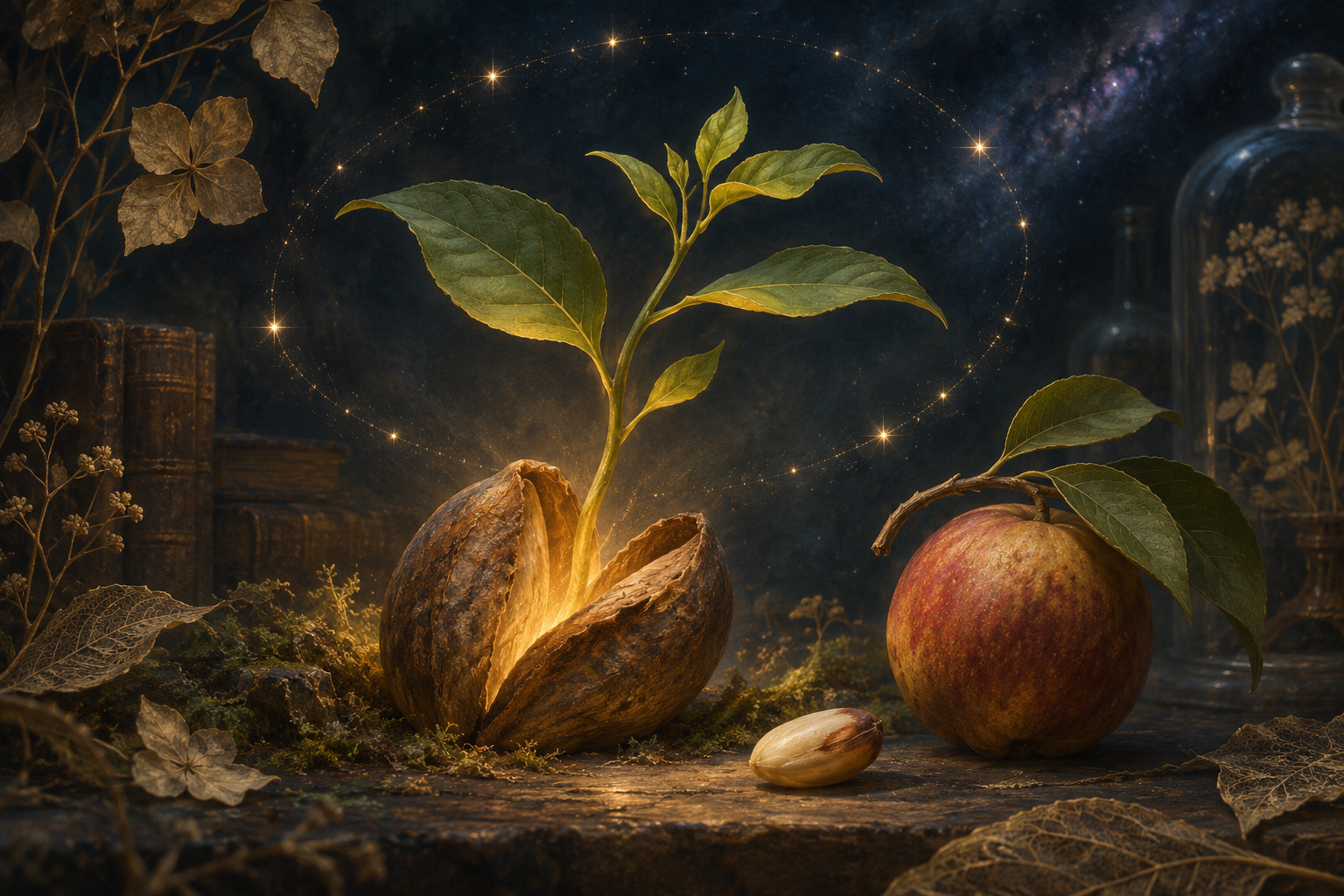
A seed represents what might grow. A future is not already a written account; it is open possibility, expectation, or a plan that may change.
The Living Library / Memory, meaning and time
A personal reading of the tree in Genesis: a seed opens into a lived moment, choices become memory, and memory helps people imagine what may come next.
An interpretive framework by Arsen Saidov · Scripture, metaphor and evidence kept distinct
Follow the timeline
The central idea / A lens for reading
My proposed lens begins with possibility, moves through a present choice, and becomes a remembered past: future → present → history. Read forward, it is a story of a seed becoming a tree and leaving another seed. Read backward, a person starts with a record and asks what earlier choices may have led to it.
This is a philosophical and literary model. It gives the tree narrative a personal meaning; it does not demonstrate that time literally reverses, that only the present exists, or that the Torah is a physics text.

The tree as a map / Genesis 2–3
In the opening chapters of Genesis, the garden contains both the tree of life and the tree of the knowledge of good and bad. The human is told not to eat from the latter; in the next chapter, the fruit is eaten. That sequence can invite reflection on boundaries, choice, consequence and knowledge.
In my metaphor, roots stand for inherited conditions and remembered history; the trunk for the moment being lived; branches and fruit for possibilities and results. A seed held inside the fruit carries the image of another beginning.
The Torah tells this story; the roots/trunk/seed mapping is my interpretation. Readers and Jewish traditions may understand these passages in different ways.
Read Genesis 2:9 on Sefaria · Genesis 2:16–24 · Genesis 3:1–7
A timeline in two directions
The arrows show how a story can be formed and later examined. They do not show a physical clock running backward.
A seed represents what might grow. A future is not already a written account; it is open possibility, expectation, or a plan that may change.
The seed is planted, tended, refused, or shared. This is the moment in which a person experiences and acts. “Present” can also mean a gift, a useful wordplay rather than proof about time.
Actions and events become the past. People preserve accounts through memory, documents, stories, and evidence. A record is a clock-like guide to sequence, not the event itself.
The reverse reading / From record to question
Start with a recorded outcome, reconstruct the choices and conditions that preceded it, then ask what different possibilities might have followed. This is retrospective reasoning: it changes how we read the story, not what happened in the past.
The cycle / A seed inside the fruit
The fruit-and-seed image makes a memorable cycle: a possibility becomes growth; growth produces outcomes; people record and interpret those outcomes; that learning can shape a new possibility. The cycle is about how human beings make meaning from time.
It is not a claim that the same event repeats or that history has one guaranteed purpose. A “greater purpose” can be a belief, a hope, or a question we bring to the record. Evidence can help establish what occurred, but meaning is interpreted.
What the sources support / What remains interpretation
Genesis describes trees, a command, eating, and consequences in the garden story. It does not label this sequence as a theory of past, present and future.
Seed, present moment, and historical record form a useful symbolic map. The “clock” is a metaphor for ordering events and reading records.
“Clockwise” depends on the observer’s viewpoint, and there is no established cosmic clock face that makes every object rotate clockwise. Cosmology tests models of the universe; this page’s tree metaphor is not such a test.
About “Otec Nebesni”: I have not found a reliable Jewish source identifying this name as a deity who administers the Cosmos. Until a verifiable source is supplied, this page treats it as a personal term or research lead, not as established Jewish tradition. Genesis 2 uses the Hebrew designation commonly rendered “the ETERNAL God” in the Sefaria JPS translation.
A number turned around / A visual example
That change can work as a graphic prompt: rotate, mirror, or rearrange selected shapes and ask what the transformed image suggests. But there is no standard mathematical operation here that turns the number into a date thousands of years in the future. A visual flip can inspire a story; it cannot establish a calendar calculation.
Sources and further reading
This page is an original personal interpretation. It is not a religious ruling or a scientific proof. Readers can compare the claims here with the linked passages and sources.
Continue through the site