
Dimensions & Detached Spaces
A “dimension” can mean more than geometry. It can mean a separate domain of rules—a container where
behavior, causality, memory, or meaning is isolated from everything else.
This page maps what “separated space” can mean in physics, information, cognition, and computation—without mythology,
without dogma, and with strict ethics.
The simplest visual model
Three “spaces” that do not touch. Each circle represents a domain with its own internal activity.
The question is: what must be true for a space to be truly detached?
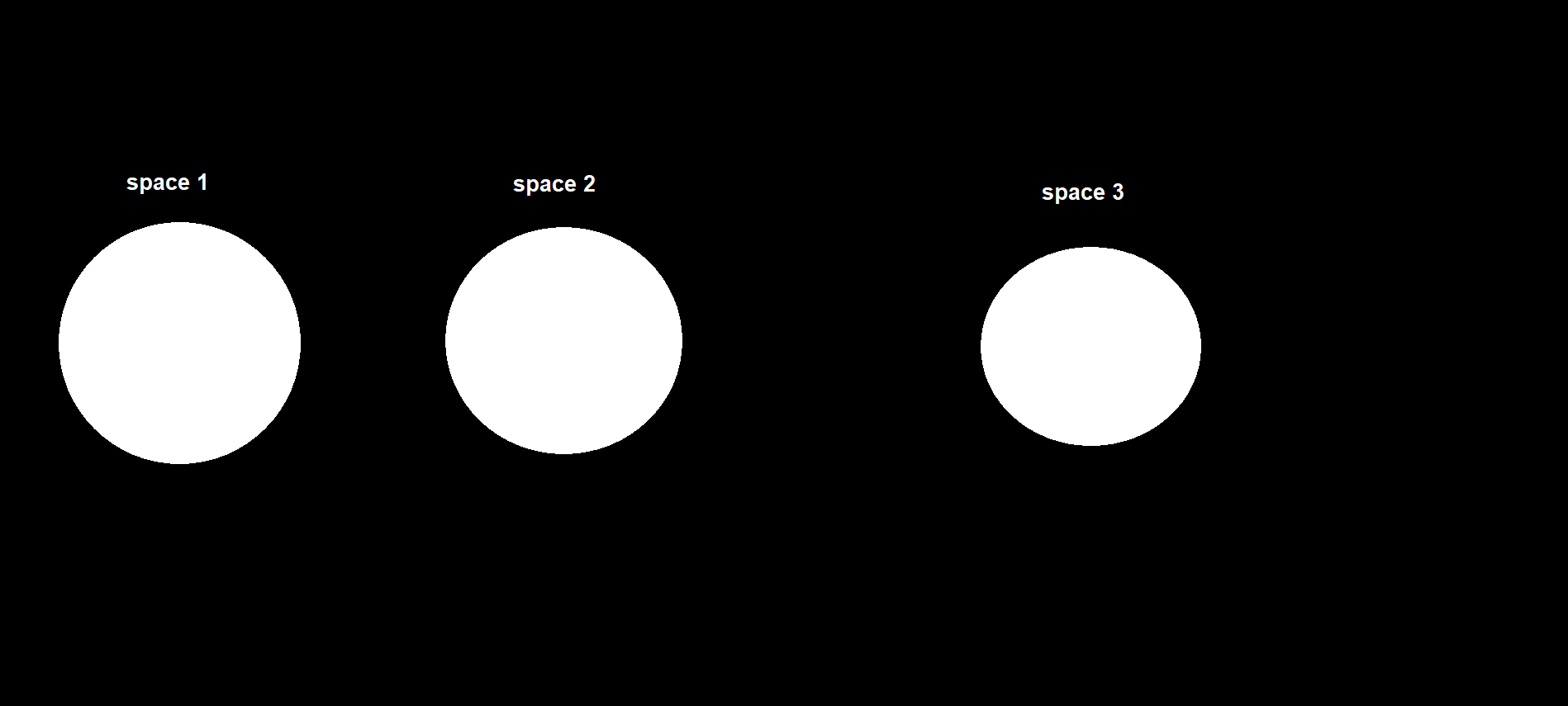
Your example diagram: Space 1, Space 2, Space 3 — each visually detached.
We treat detachment as a measurable idea: boundary rules, information flow, and causal isolation.
Working definition
A Detached Space is a domain where:
- Rules differ (its own “physics” or logic).
- Information does not leak across the boundary (or leakage is controlled).
- Causality is isolated (events inside cannot affect outside, unless a bridge exists).
- Identity continuity is preserved internally (the space “remembers itself”).
never to justify harm, domination, or dehumanization.
Taxonomy: what people call “dimensions”
1) Geometric dimensions (classic)
Length, width, height, time—coordinates that locate events.
Here, “dimension” means degrees of freedom.
Useful, but it’s only one meaning of “dimension.”
2) Physical domains (different rule-sets)
A domain can behave as if it has different constraints:
changed constants, altered propagation limits, or unusual boundary behavior.
Detachment is about rule separation, not just “far away.”
3) Information dimensions
A dimension can be an information axis: a channel of meaning.
Think: signal-to-noise, compression, error-correction, and coherence.
Some “spaces” are more like data structures than locations.
4) Cognitive dimensions
Attention, memory, emotion, intention—internal “spaces” that shape reality for an observer.
A mind can generate a detached space by maintaining a stable internal boundary:
what enters, what is filtered, what is allowed to rewrite identity.
5) Computational / simulated spaces
Sandboxes, virtual machines, containers, isolated networks.
These are real examples of “detached spaces” built by design:
the boundary is enforceable, testable, auditable.
6) Social / legal dimensions
Not physics—yet still “real”: jurisdictions, privacy zones, safe spaces, roles.
These dimensions are made of rules, not particles.
They matter because they change outcomes.
So we treat “dimension” as structure + boundary + coherence—not as a fantasy label.